
When one comes across a pentagram engraved above a barn door in Dordogne or on a Roman lintel, the first reaction is rarely to think of the devil. Instead, one thinks of a stone mason’s sign or a mark of protection. Yet it is the same five-pointed design that popular culture today associates with satanism. Understanding how we transitioned from one to the other requires looking back at very concrete uses, far from fantasies.
Pentagram engraved on buildings: a protective use, not an invocation
On the ground, the oldest function of the pentagram is apotropaic, meaning intended to ward off evil. This symbol can be found on thresholds of houses, stables, and Romanesque churches throughout Western Europe. It is not for decoration: builders used it as a symbolic lock against malevolent spirits.
In medieval manuscripts, the upright pentagram represents the five senses mastered by reason. The Pythagorean tradition, long before the Middle Ages, already saw it as a sign of mathematical harmony linked to the golden ratio. There was no demonic connotation at that time.
To learn everything about the star of satan and its multiple interpretations through the centuries, one must accept that the same geometric design has carried radically opposing meanings over time.
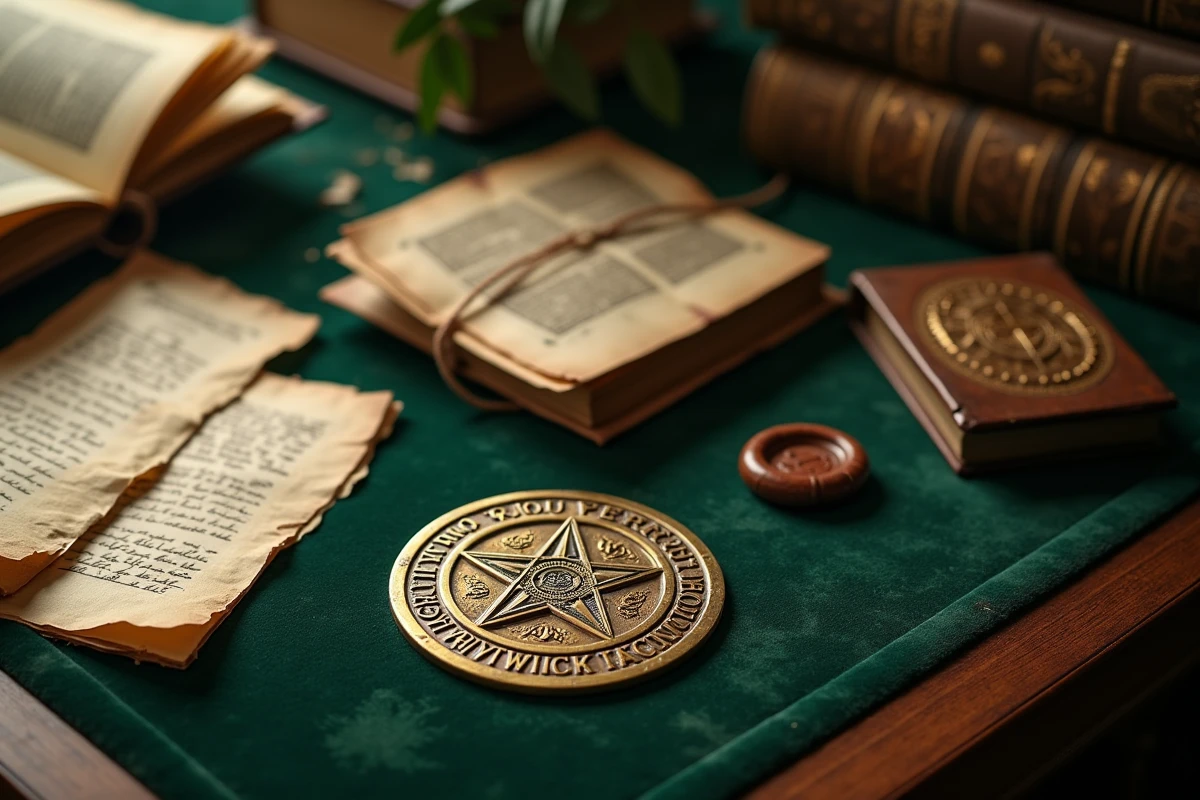
Seal of Solomon and Freemasonry: two distinct appropriations of the symbol
The Seal of Solomon, often confused with the pentagram, sometimes refers to the five-pointed star, sometimes to the six-pointed hexagram. This confusion fuels a significant portion of the theories linking Freemasonry and satanism. In reality, these two geometric figures have neither the same origin nor the same ritual function.
In Masonic tradition, the five-pointed blazing star symbolizes the light of knowledge. It appears in the second degree of the rite, associated with the letter G (Geometry or God depending on the lodges). The Grand Orient of France, in its recent publications, connects this star to rational illumination, not to any satanic rebellion.
The confusion partly arises from 19th-century authors who mixed Masonic symbolism with occultism. Éliphas Lévi, in particular, popularized the idea of an inverted pentagram associated with the goat of Mendes. This overlap between two distinct traditions has created a blend that persists.
What the inverted pentagram concretely changes
The orientation of the symbol is the pivot of the whole matter. Pointing upwards: the spirit dominates matter, a classic and protective reading. Pointing downwards: matter dominates the spirit, a reading that opens the door to satanic interpretations from the 19th century onwards.
It should be noted that this distinction did not exist in Antiquity. Pythagoreans drew the pentagram in both directions without attaching different moral values to it. This is a modern construct, not an ancient legacy.
Satanic star and Church of Satan: a political appropriation of the 20th century
Anton LaVey founded the Church of Satan in 1966 and adopted the inverted pentagram inscribed in a circle, with a goat’s head, as its official emblem. This choice is as much aesthetic as it is strategic: it aims to provoke a conservative American society by turning a loaded symbol on its head.
LaVey’s satanism has little to do with the demonic rituals fantasized by the press. His doctrine is based on radical individualism and the rejection of religious authority. The inverted pentagram functions here as a marker of cultural opposition, not as a tool for invocation.
- LaVey’s satanic star takes the design from Éliphas Lévi but drains it of its esoteric content to make it an identity logo
- The Satanic Temple, founded more recently, uses the same symbol in a militant approach focused on the separation of church and state in the United States
- In European neo-pagan practices, the inverted pentagram is experiencing a resurgence of protective use, countering its exclusive association with satanism

Pentagram in popular culture: how cinema has fixed the image
The horror genre has made the inverted pentagram drawn on the ground a nearly mandatory visual cliché. This imagery, repeated from film to film since the 1960s, has ultimately overshadowed all other meanings of the symbol in the minds of the general public.
The concrete result is that a tattoo artist who receives a request for a pentagram must today systematically clarify the client’s intention. Feedback from professionals also indicates a decline in requests for satanic stars in recent years, in favor of positive or geometric interpretations of the same motif. Social media has contributed to this rehabilitation by disseminating historical content that places the symbol back in its chronological depth.
In France, the debate has taken a regulatory turn with the ban on the inverted five-pointed star in public schools since January 2025, as part of discussions on secularism and sectarian symbols (decree n°2025-47). This measure illustrates the difficulty in addressing a symbol whose meaning entirely depends on the context of use.
The pentagram remains a case study in symbolism: the same geometric design can protect a medieval house and scandalize a board of directors. The only constant is the emotional charge that each era projects onto five intersecting lines.