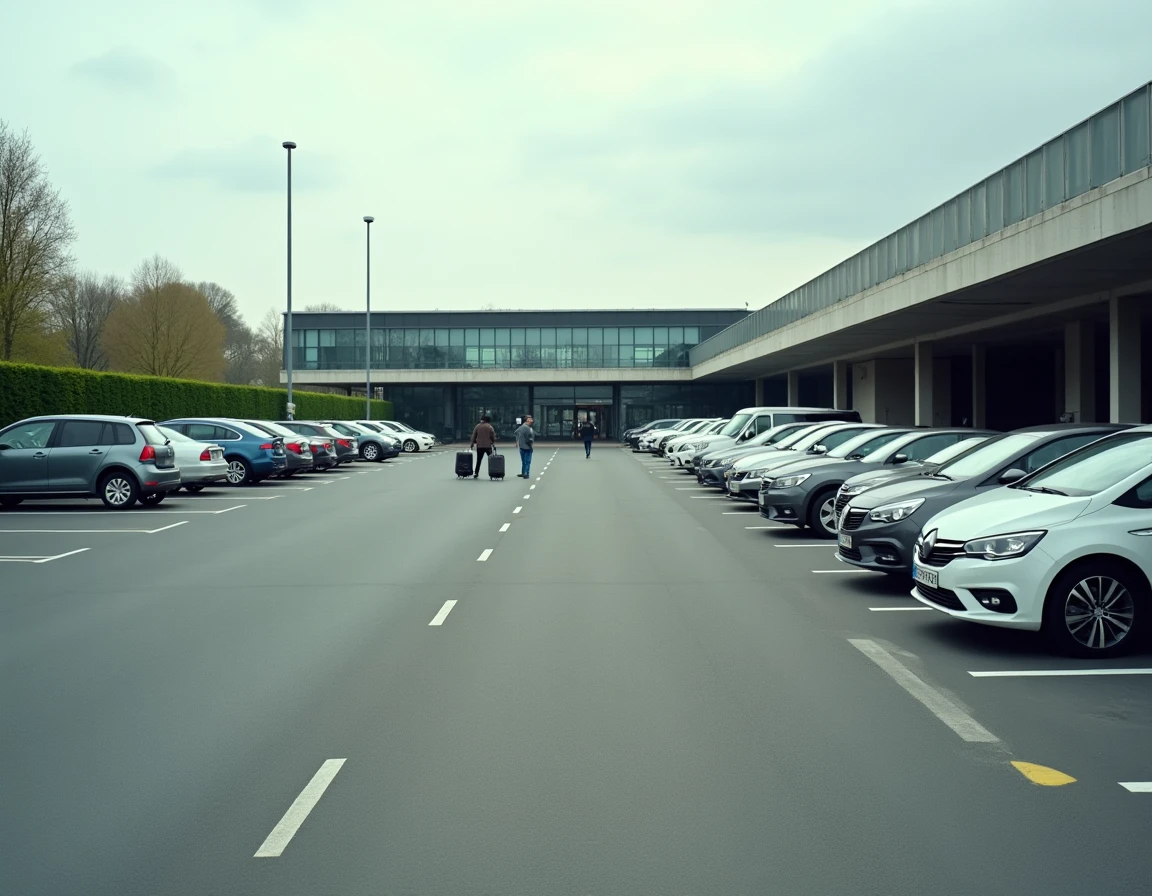
Finding free parking at Rennes train station has become an increasingly challenging task. The parking policy implemented by Rennes Métropole aims to reduce the presence of long-term vehicles on the surface around the station. Free spaces in the immediate vicinity have dwindled in recent years, replaced by paid parking with quick turnover or by pedestrian and cycling facilities.
Line B of the metro and multimodal strategy: what changes for parking near Rennes station
The opening of Line B of the metro has reshuffled the cards for free parking around the station. Before this service began, drivers searched for a spot in the nearby residential streets. Since then, the Métropole has directed users towards a different scheme: park on the outskirts and then reach the station via the STAR network.
This network relies on park-and-ride facilities (P+R) connected to metro and bus lines. Several of these P+R allow free parking all day as long as you hold a valid STAR transport ticket. The journey to the station then takes only a few minutes, making it a realistic alternative to surface parking.
Field reports vary on this point: some regular users find the P+R full by mid-morning on weekdays, while others consider them accessible if they arrive early. The issue is particularly relevant for those taking an early TER. To identify the areas of free parking at Rennes station and elsewhere in the city, the mapping of P+R and non-regulated streets remains the most reliable starting point.

Free park-and-ride facilities in Rennes: actual access conditions and limitations
The principle seems simple: park your car in a P+R, validate a STAR ticket, and leave by public transport. The free parking is real, but it remains conditional on holding an active transport ticket. Without validation, the vehicle may be considered in violation according to the park’s regulations.
Not all P+R are equal in terms of proximity to the station. Those connected to Line B offer direct access, while others require a bus-metro transfer that extends travel time. For departures on TGV or TER, the choice of P+R affects the time margin to plan.
What to check before choosing a P+R
- Direct service by metro Line A or B, without transfer, to limit travel time to the station
- The opening hours of the park, as some P+R close at night or on weekends, which poses a problem for long-term parking
- The remaining capacity during peak hours: P+R near line terminals fill up faster than those located in the middle of the line
The available data does not provide a reliable occupancy rate for each park. The Métropole offers an interactive parking map for its territory, which can help identify the least busy sites.
Free parking in the streets near Rennes station: what remains accessible
Around the station, free surface parking without time limits has almost disappeared. Successive parking plans have expanded paid zones and strengthened control through license plate reading. The few remaining pockets of free parking are found in residential streets located more than ten minutes on foot from the station, often beyond Boulevard de la Liberté or towards the southern district.
These spots are not marked as “station parking” and do not appear on any official dedicated map. They correspond to sections of roadway where the Métropole has not yet deployed a regulated zone. Their sustainability is not guaranteed: each year, new streets shift to paid zones during revisions of the parking plan.
Concrete risks of long-term wild parking
Leaving a vehicle for several days in a free street near the station exposes you to two problems. The first is regulatory: a vehicle that remains stationary for more than seven consecutive days on public roads can be reported as abandoned and may be towed. The second is practical: unmonitored streets are also those where the risks of damage or theft are highest, without video surveillance coverage.

Combining P+R and TER: the underutilized option for free parking
A practice still little documented in local guides is to park in a peripheral town served by the TER, then reach Rennes station by train. Several TER stops located just minutes from Rennes have small free parking lots, often not full, as they are not integrated into the Métropole’s P+R network.
This option requires checking the frequency of TER on the relevant line and the ticket cost compared to a metro ticket. However, it offers free parking without the condition of a STAR ticket, which distinguishes it from metropolitan P+R.
- Identify suburban TER stations with free parking (the smallest stops are often the least crowded)
- Compare the total travel time (road + TER) with that of P+R + metro to assess the real gain
- Check that the parking at the TER stop does not shift to a regulated zone, as some towns are gradually aligning their policies with those of the Métropole
Free parking around Rennes station no longer exists in the traditional sense. Solutions now involve a deliberate modal shift towards P+R or suburban TER stops. Free parking remains accessible, but it requires planning that a simple tour of the station area can no longer provide.