
Organizing a school trip requires teachers to juggle educational objectives, administrative constraints, and a tight budget. For several months now, the platform Partir en Classe has evolved its tools to simplify several steps of this process. Here’s what these changes concretely bring to the educational teams preparing for their upcoming trips.
Administrative forms and deadlines: what’s changing for school trips
Have you ever spent hours gathering the pieces of a school trip file without knowing if your list was complete? Several academies, such as Dijon, have recently introduced new mandatory or strongly recommended documents: a preliminary budget sheet, a transportation information sheet, and a standardized authorization request form. These documents often need to be submitted within a strict timeframe, usually four to six weeks before departure depending on the destination.
This tightening of documentation responds to a logic of traceability. Teachers who discover these requirements late in their preparation find themselves scrambling for signatures and quotes. Centralizing information on these forms, their updated versions, and the associated deadlines becomes a real time saver.
By browsing the news from Partir en Classe, one can find updated resources that point to these regulatory changes. The advantage is to have a single entry point rather than navigating between the websites of each academy.
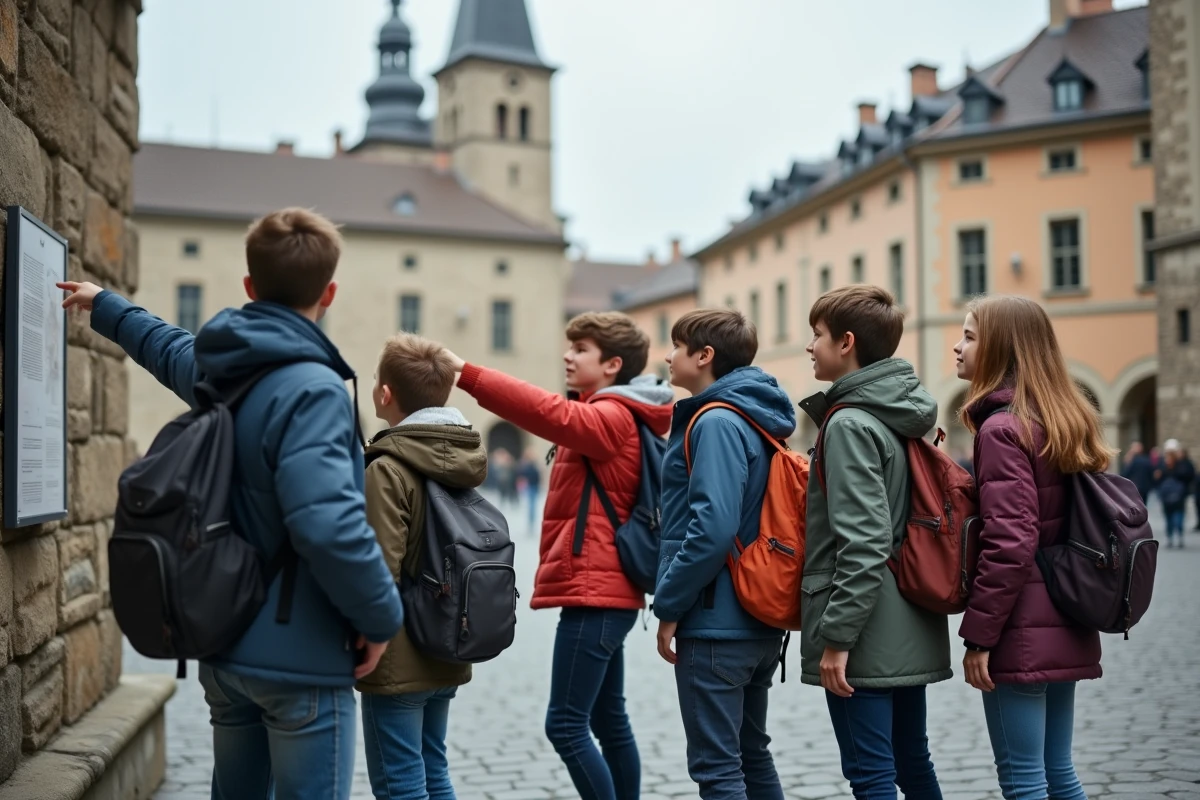
Inclusion and risk management: adapting the school trip for all students
Since the start of the 2023-2024 school year, several academies have more explicitly integrated two dimensions into their circulars on school outings: adaptation for students with special educational needs (disabilities, DYS disorders, PAI) and enhanced risk management (Vigipirate plan, climate hazards).
For a teacher preparing a discovery class, this translates into dedicated risk analysis grids and specific forms. These documents are not included in the usual general guides.
Preparing an accessible trip
The accessibility of a trip is not limited to choosing suitable accommodation. It also concerns the pace of activities, rest periods, and the possibility of following a medical protocol (PAI) outside the school. Anticipating these needs from the scouting phase of the reception center avoids last-minute adjustments that burden the entire team.
Platforms that list educational trips are beginning to highlight structures whose facilities and programs take these constraints into account. This is still a selection criterion that is not often emphasized, but it makes a difference on the ground.
Funding a school trip: concrete levers and pitfalls to avoid
The budget remains the primary obstacle to organizing a school trip. Several strategies exist to secure funding, but some deserve more attention than others.
- School cooperatives and parent associations often serve as the first lever, provided they are approached early in the school year so they can integrate the project into their own budget.
- Grants from local authorities (town hall, department, region) vary greatly from one area to another. Consult your administration about local schemes before preparing the file.
- Self-funding activities (cake sales, raffles, performances) remain effective but require a time investment that the educational team must evaluate against the actual amount collected.
- Some organizations offer preferential rates for departures at the beginning of the term, outside of peak demand periods. Shifting a trip by a few weeks can significantly reduce transportation and accommodation costs.
The most common pitfall: underestimating additional costs (insurance, special meals, educational materials). The preliminary budget sheet required by some academies forces a listing of these items in advance, which protects against unpleasant surprises.

School trip in Périgord: an example of an educational destination
Périgord offers a particularly rich environment for discovery classes. Between prehistoric sites, rivers suitable for nature activities, and farms open to school groups, programs can intersect history, science, and environmental education within the same territory.
Why Périgord is suitable for multidisciplinary trips
A trip lasting three to five days allows for combining visits to decorated caves (to anchor the history program), a canoe outing on the Vézère or Dordogne (science, geography), and a workshop at a local farm (education for sustainable development). This density of educational resources within a limited area minimizes transportation time between activities.
For teachers who are hesitating between several regions, the criterion of the relationship between educational richness and travel distance is often decisive. A compact territory reduces student fatigue and simplifies daily logistics.
The reception structures in the Lanouaille sector and the green Périgord offer packages tailored for school groups, with local facilitators accustomed to working with children from different cycles.
Organizing a school trip remains a demanding exercise, but the tools are evolving in the right direction. The new academic forms, even if they add an administrative layer, protect teachers as much as students. And choosing a destination where the educational density justifies each day spent outside the classroom is the best argument to present to parents as well as to the administration.