Homemade mayonnaise is based on a simple physical principle: dispersing oil into microscopic droplets in an aqueous phase, all stabilized by the lecithin in the egg yolk. The whisk used for this operation is not a neutral accessory. It determines the shear finesse, and thus the stability of the emulsion. An unsuitable whisk does not result in a failed mayonnaise due to lack of technique, but rather a mixture that simply does not come together.
Stainless steel, silicone, unidentified alloy: what the material really changes
Most cooking guides compare whisks by their shape. The material of the wires often takes a back seat, even though it plays a direct role in the stability of the emulsion and food safety.
Recent comparative tests show that all-stainless steel whisks produce a more stable emulsion over time than models with silicone-coated wires or non-stick coatings. The reason lies in the surface of the wires: silicone tends to cling more to the fat on the coating and retains the fine droplets less effectively in the mixture. Mayonnaise whipped with a coated whisk can release oil (visible exudation) after a few hours in the refrigerator.
To know which whisk to choose for mayonnaise based on your usage, the question of material should be considered before that of shape.
Mayonnaise contains acidic ingredients (mustard, vinegar, lemon juice). An acidic environment increases the risk of migration of compounds from unidentified alloys or untracked plastics.
Since the strengthening of European recommendations on materials in contact with food (EC regulations No. 1935/2004 and 10/2011, with updates in several national guides between 2022 and 2024), consumer associations are increasingly directing towards whisks made of certified food contact stainless steel. For a whisk costing a few euros bought online, this certification is rarely guaranteed.
Number of wires and spacing: the real shear criterion for whipping mayonnaise
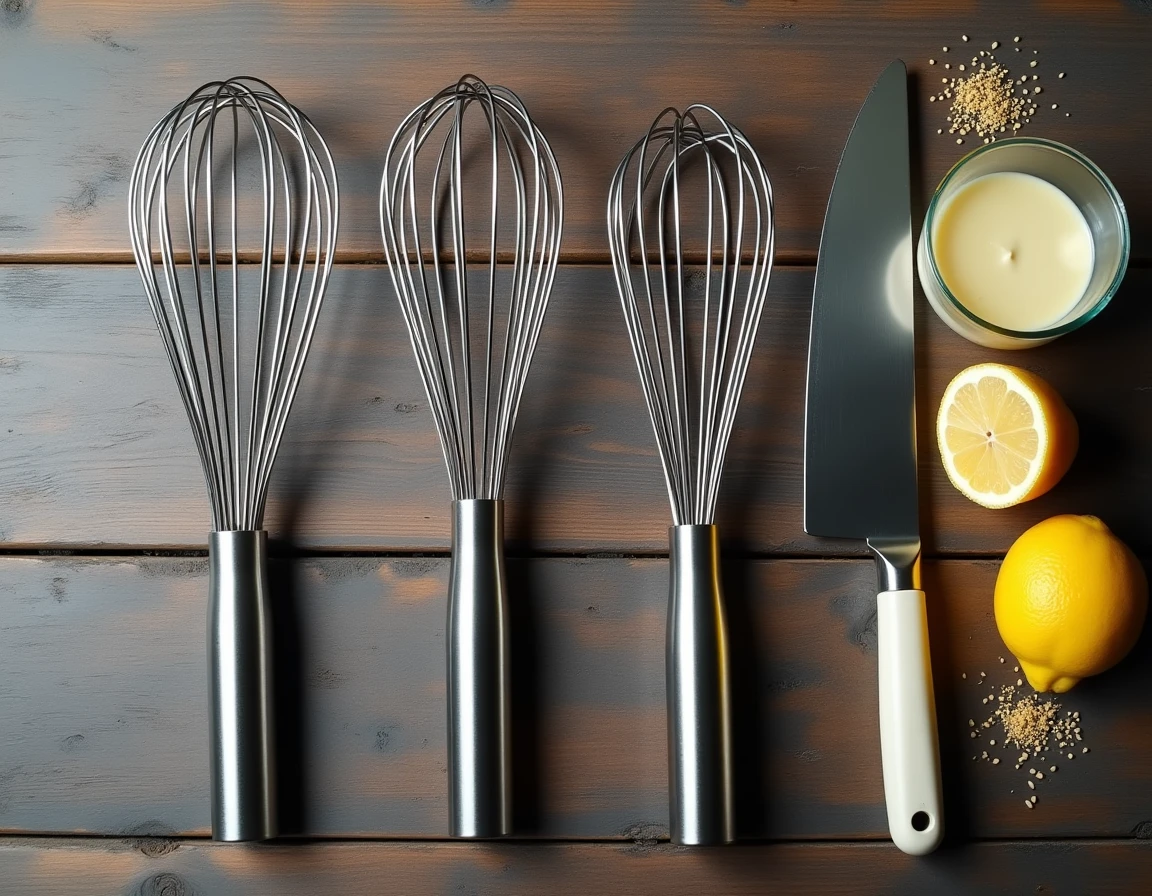
The general shape of the whisk (balloon, straight, flat) is a comfort criterion. The criterion that determines the quality of the emulsion is the number of wires and their spacing.
Each wire that passes through the mixture cuts the oil droplets into smaller fractions. The more wires there are and the closer they are together, the more frequent the shear is with each wrist rotation. The result: finer droplets, a firmer emulsion, and mayonnaise that holds better over time.
Classic balloon whisk
The balloon whisk with rounded and numerous wires remains the standard for mayonnaise. Its bulbous shape allows for air incorporation while ensuring consistent shear. It is the model used in most professional kitchens for cold emulsions.
Fine wire whisks: the semi-professional trend
In restaurants and with some caterers, there has been a trend in recent years towards the adoption of very fine wire whisks for quick emulsions in small quantities. These models, sometimes called “piano whisks” or “sauce whisks,” concentrate the shear on a reduced volume. To whip mayonnaise from a single egg yolk, they are more effective than a large balloon whisk that stirs air in a bowl that is too wide.
False friends: spring whisk and fancy mini-whisk
The spring whisk (a metal spiral at the end of a handle) does not produce sufficient shear to properly fragment the oil. It mixes, it does not shear. Decorative mini-whisks pose the same problem: too few wires, too far apart, too short. A whisk that does not shear enough produces an oily liquid, not an emulsion.
Manual whisk or electric mixer for mayonnaise: when the question arises
The electric mixer or immersion blender produces mayonnaise in a matter of seconds. The result is often satisfactory in terms of stability. The question is not which is “better” in absolute terms, but to understand what each tool does differently.
The manual whisk allows for precise control of the oil flow. It is this flow that determines the success of the emulsion from the start: too much oil at once, and the droplets are too large to be stabilized by the lecithin. The manual whisk forces you to incorporate the oil slowly, which reduces the risk of failure.
The immersion blender, on the other hand, operates at a speed sufficient to compensate for a faster addition of oil. The blender tolerates more technical errors than the manual whisk. However, the texture obtained differs: mayonnaise made with a manual whisk often has a finer grain and a more pronounced shine because the incorporation of air is less.
- Manual whisk: flow control, fine and shiny texture, suitable for small quantities (one to two egg yolks).
- Electric whisk: fast, but the risk of over-incorporating air sometimes results in a foamy rather than creamy texture.
- Immersion blender: tolerates rapid oil addition, homogeneous result in seconds, but slightly less silky texture than with a whisk.

Whisk maintenance and hygiene: a neglected criterion for mayonnaise
Raw mayonnaise based on egg yolk is a favorable ground for bacterial development. The whisk used to whip it must be able to be cleaned perfectly, without retention areas.
Whisks with a welded and open handle-wire junction are easy to rinse. Those with a plastic sleeve covering the base of the wires trap residues between the plastic and the metal. Incomplete drying in this area can promote bacterial proliferation.
- Prefer a whisk whose junction between the handle and the wires is visible and accessible for washing.
- Detachable whisks (handle separable from the head) allow for complete cleaning, a still rare but relevant argument.
- Running the whisk through the dishwasher is not always sufficient: check for the absence of residues at the base of the wires after each cycle.
The choice of a whisk for mayonnaise is not just a matter of price or design. The material of the wires, their number, and their spacing determine the quality of the emulsion far more than the brand printed on the handle. In case of doubt, an all-stainless steel balloon whisk with closely spaced wires and a clean junction remains the most reliable choice for achieving firm, stable mayonnaise without health risks.