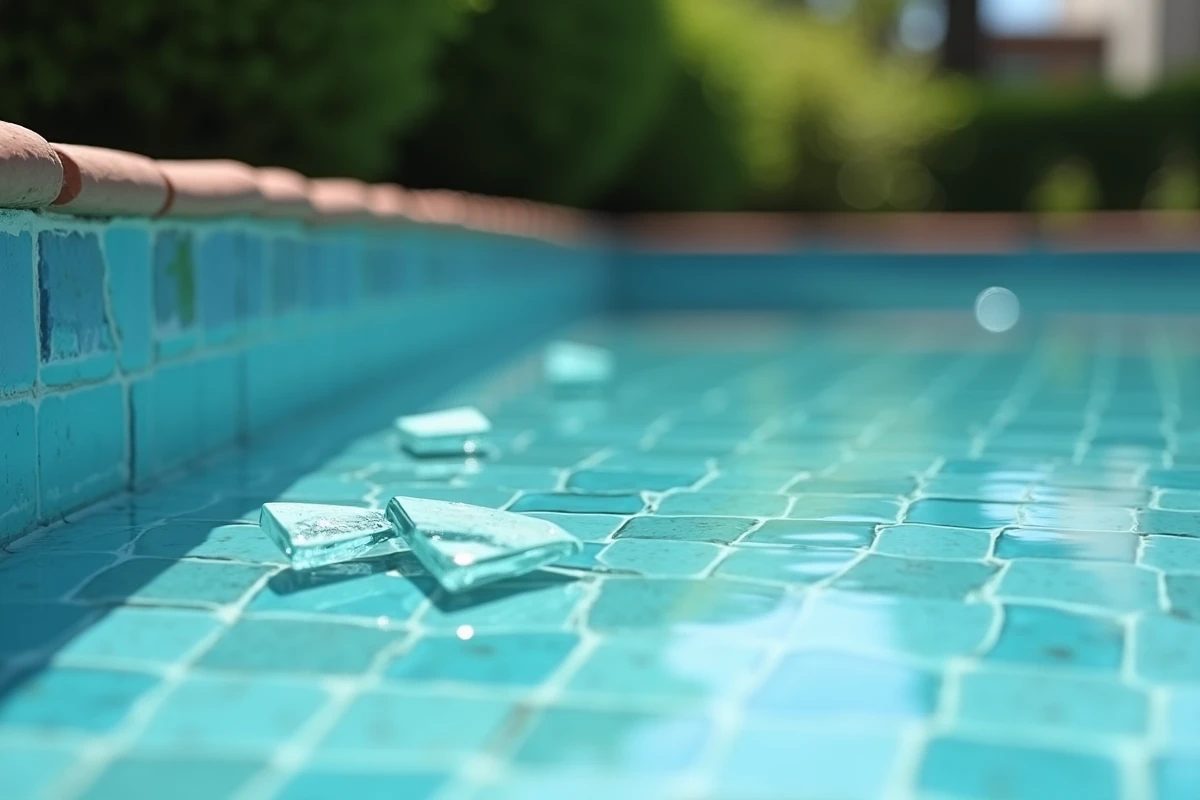
A glass that falls on the coping, a bottle knocked over by a gust of wind, a light fixture that bursts due to thermal shock: scenarios of glass breakage in a pool are more common than one might think. The shards scatter in a matter of seconds, some visible to the naked eye, others microscopic and nearly undetectable.
The subsequent cleaning allows for no approximation, as the health risks are real and method errors can permanently damage the filtration equipment.
Why a pool robot should not be used after glass breakage
The first instinct of many owners is to start the robot to vacuum up the debris at the bottom of the pool. This instinct is counterproductive and potentially costly.
Technical notices for Polaris and Zodiac robots, updated since 2023, specify that the suction of glass shards can irreversibly damage the turbine and tracks of the robot. The fragments get stuck in the internal mechanism, causing scratches on the components and blocking rotation. This type of damage is generally not covered by the manufacturer’s warranty.
The sand filter or cartridge filter of the main circuit poses a similar problem. Fine shards pass through the pump’s pre-filter baskets and become lodged in the filtering media.
With filtering glass, the broken glass fragments mix with the media and become impossible to extract.
To learn how to remove glass from the pool without damaging your equipment, the basic rule remains to turn off the filtration as soon as the incident is discovered.
Step-by-step method for cleaning broken glass in the pool
Manual removal remains the only reliable approach for an individual. Before any intervention, turn off the filtration system and the pump. No water should circulate while shards may be suspended or lying on the pool floor.
Spotting invisible shards
Wait until nightfall. Dive with a waterproof flashlight angled towards the bottom: the light reflects off each fragment, even the tiniest. This technique, widely confirmed by feedback from professional pool technicians, allows for the location of shards that daylight does not reveal.
If your pool has built-in lighting, turn it on as a complement. The combination of the two light sources covers blind spots.
Collecting without dispersing
- Wear thick cut-resistant gloves (level 5 cut-resistant gloves) and rigid-soled water shoes if you enter the pool.
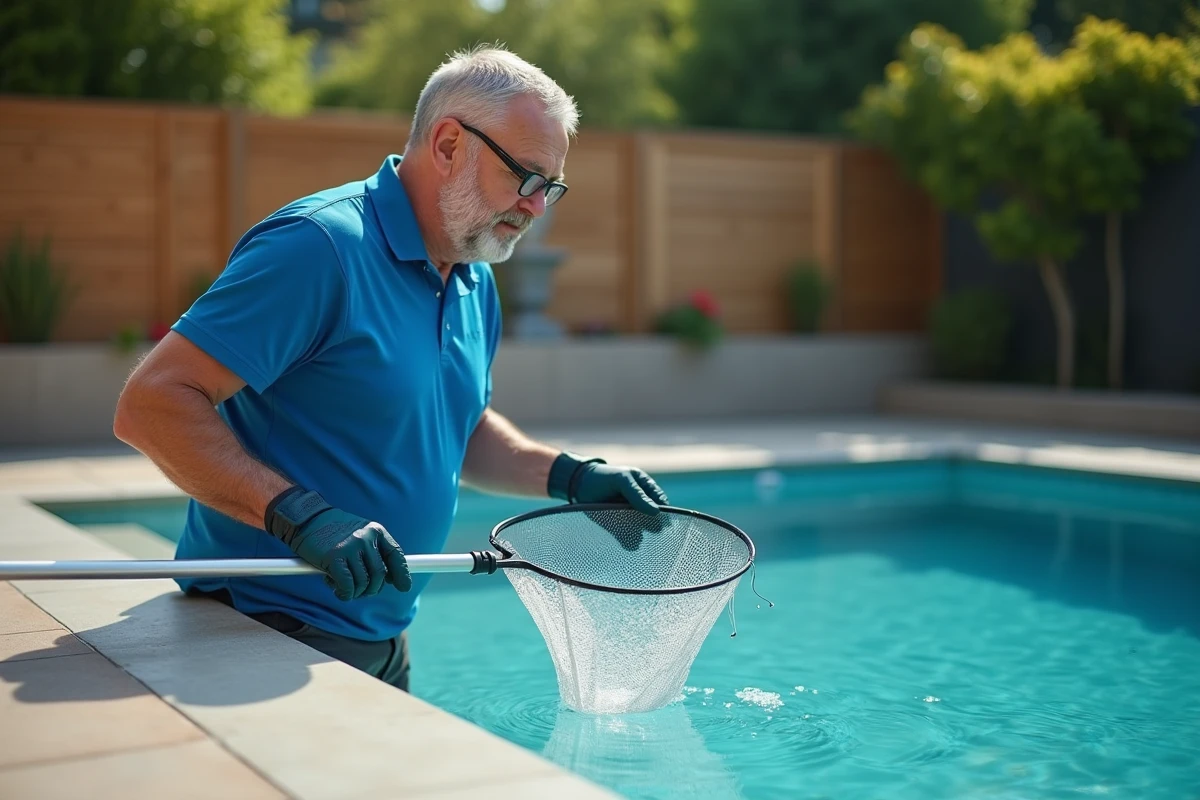
- Use a fine mesh net to collect the suspended fragments or those lying on the steps and bench.
- For microscopic shards stuck to the liner or tiles, apply a piece of modeling clay or soft putty that you press against the floor: the fragments adhere to the putty without scratching the surface.
- Then slowly brush the bottom of the pool towards a single collection point, and vacuum this area using a vacuum head connected to the drain (not to the filtration circuit).
Suction should always be directed to the drain, never through the filter. Sending water laden with glass into the sand filter or return pipes creates a risk of clogging and damage to the strainers.
Public pool and broken glass safety protocol: what changes
The treatment of glass breakage in a public pool is not comparable to that of a private pool. The internal protocols of municipal pools, published or summarized between 2022 and 2024, require immediate evacuation of the pool and prolonged closure for several hours.
The standard procedure includes a systematic search for shards followed by double filtration before reopening. The pool only reopens after validation by the technical manager. The French Swimming Federation and some public aquatic centers have strengthened these requirements in their post-Covid safety guides.
For an individual, this rigor may seem excessive. However, it provides a clear indication: a single cleaning pass is not enough. Repeating the nighttime inspection with a flashlight at least twice, one day apart, significantly reduces the risk of a forgotten fragment.
Home insurance and coverage for pool glass breakage
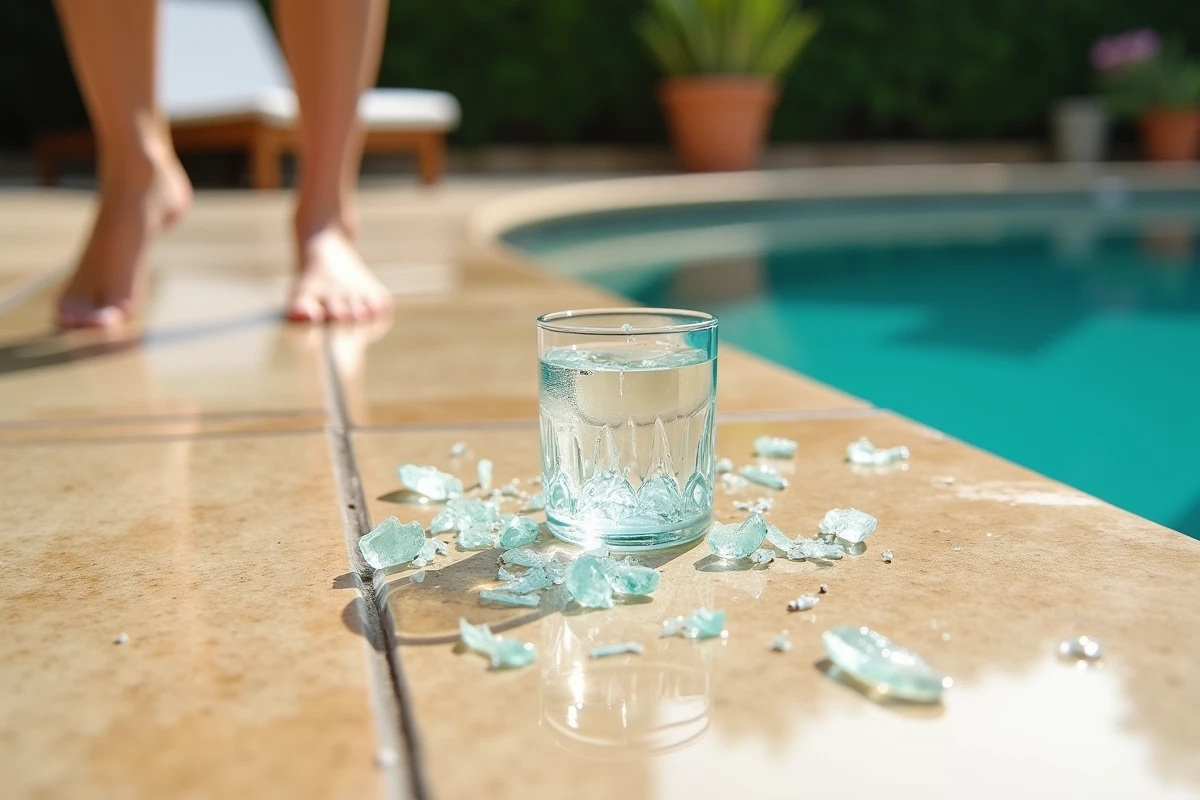
Several home insurers in France (MAIF general conditions 2024, Allianz Home 2023) indicate that glass breakage in or around the pool, whether it is a table glass, a bay window, a windbreak, or a shelter, can be compensated under the glass breakage or accidental damage coverage.
The available data does not allow for generalization: each contract sets its own exclusions and limits. Field feedback diverges on a recurring point. The costs of complete draining and cleaning of the pool are often excluded or subject to a specific limit, distinct from that of the glass breakage itself.
Before initiating a drain or calling in a pool technician, contact your insurer to check what is covered. Photograph the scene and keep the debris as evidence.
Prevention of glass breakage around the pool
Prevention remains the most effective lever. A few material choices drastically reduce the risk:
- Replace traditional glassware with polycarbonate or tritan cups, visually similar to glass but unbreakable.
- Regularly check submerged light fixtures and portholes: an aged seal or insufficient tightening promotes bursting due to temperature variations in the water.
- If a tempered glass pool cover is installed, ensure that the panels comply with current standards and that no nickel sulfide inclusions were reported during installation (a known cause of spontaneous bursting of tempered glass).
Replacing glassware around the pool costs little compared to a cleaning intervention after an incident. A liner scratched by an undetected shard, a non-functional robot, a partial drain not reimbursed by insurance: the bill can quickly add up when the glass has already touched the water.