Blast freezers and regular freezers are often confused in buying guides aimed at consumers. The difference lies in the rate of temperature drop: a blast freezer lowers the temperature of food in just a few tens of minutes, while a standard freezer takes several hours. This speed alters the size of the ice crystals formed within the food cells, which has a direct effect on texture and nutritional value after thawing.
Investing in a personal blast freezer raises a specific question: at what level of need does this device provide a measurable gain compared to a standard storage freezer?
Home freezing and traditional freezing: what speed really changes
Most consumer content presents the blast freezer as a more efficient freezer. This simplification masks a crucial technical point. Blast freezing produces micro-crystals of ice that do not puncture the cell walls of food. Slow freezing, on the other hand, generates larger crystals that damage the internal structure of the products.
In practical terms, a fruit or a quickly frozen dish retains its texture better upon thawing. Water loss is reduced, and the taste qualities remain closer to their fresh state. This mechanism is well documented in professional references in the restaurant and food industry.
To learn everything about personal blast freezers, it should be noted that this device does not replace a storage freezer. It is used to quickly lower the temperature, after which the food is transferred to a standard freezer for long-term storage. The two devices work in complementarity.
Blast freezing temperature and operating ranges: comparison table
The temperature differences between a domestic freezer and a blast freezer explain the difference in results on food. Here are the usual ranges documented in professional sources:
| Criterion | Domestic Freezer | Blast Freezer |
|---|---|---|
| Operating Temperature | About -18 °C | Between -30 °C and -50 °C |
| Time to reach the core of the food | Several hours | A few tens of minutes |
| Size of ice crystals | Large crystals | Micro-crystals |
| Preservation of texture after thawing | Frequent degradation | Much better preservation |
| Main Use | Long-term storage | Rapid temperature drop |
The range of -30 to -50 °C of the blast freezer allows for rapid cooling to the core of the food. This ability to quickly pass through the critical crystallization zone (between 0 and -5 °C) is the factor that preserves the quality of the products.
Usage cycle and stock rotation: the true profitability criterion
Buying guides emphasize the volume of the device. The determining criterion for a household is not the gross capacity, but the frequency with which you blast freeze preparations.
A blast freezer is justified if you regularly prepare meals using batch cooking, if you process fresh produce from the garden or market in large quantities, or if you store sensitive pastry preparations. Outside of these uses, a standard freezer is sufficient.
- Weekly batch cooking with blast freezing of individual portions: the blast freezer shortens processing time and improves the quality of cooked dishes
- Seasonal processing of fresh fruits and vegetables in quantity: rapid blast freezing limits oxidation and vitamin loss compared to slow freezing
- Home pastry or baking preparations: yeast doughs, pastries, pie crusts handle blast freezing much better than traditional freezing
If you only occasionally blast freeze a few leftovers, investing in a blast freezer is not cost-effective. The regularity of the blast freezing cycle determines the return on investment.
Energy consumption and energy class: a professional device in a household
The blast freezer is a device originally designed for professional use. When integrated into a household, it raises the question of electricity consumption. Professional models consume more than a standard domestic freezer, particularly because they reach much lower temperatures.
Before purchasing, check the energy class of the device. Recent models incorporate more efficient compressors, but the consumption remains higher than that of a conventional freezer of equivalent volume. This additional energy cost should be weighed against the qualitative gain on food and the reduction of food waste.
A point rarely addressed: the blast freezer operates in short and intense cycles. It is not constantly in use like a storage freezer. Its actual consumption therefore directly depends on the frequency of use. A household that uses it twice a week will not incur the same bill as a professional who runs it continuously.

Available space and installation constraints in a domestic kitchen
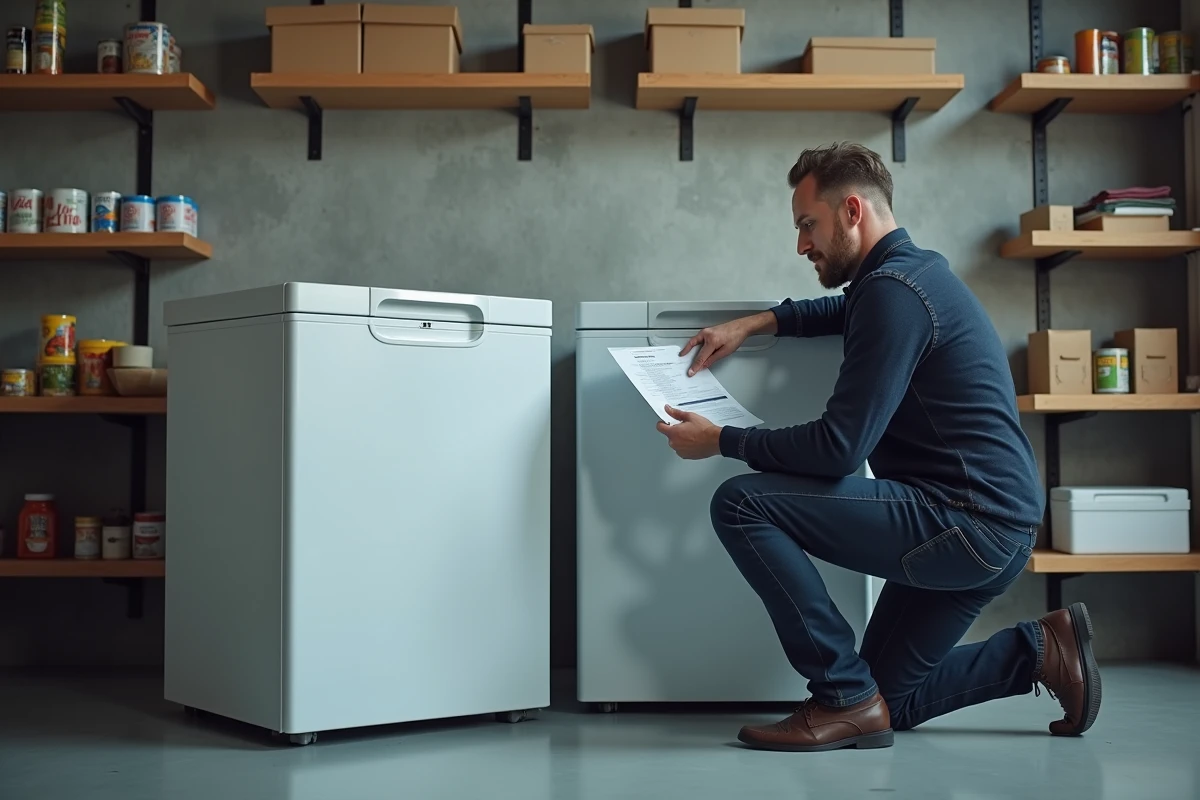
Professional blast freezers are sized for technical premises. Some compact models exist, but they are still bulkier than a standard chest or upright freezer.
- Check the necessary ventilation around the device: a blast freezer generates more heat than a standard freezer and requires sufficient clearance space
- The noise level may be higher, especially during rapid temperature drop phases
- The electrical supply must support the power of the compressor, which often exceeds that of a typical household appliance
The ideal location remains a pantry, garage, or laundry room rather than an open kitchen. A poorly ventilated blast freezer consumes more and wears out faster.
Purchasing a blast freezer for a household is justified by regular blast freezing use, not simply by the desire to have a more efficient cold appliance. Stock rotation and preparation frequency remain the two variables that separate a relevant investment from oversized equipment.